
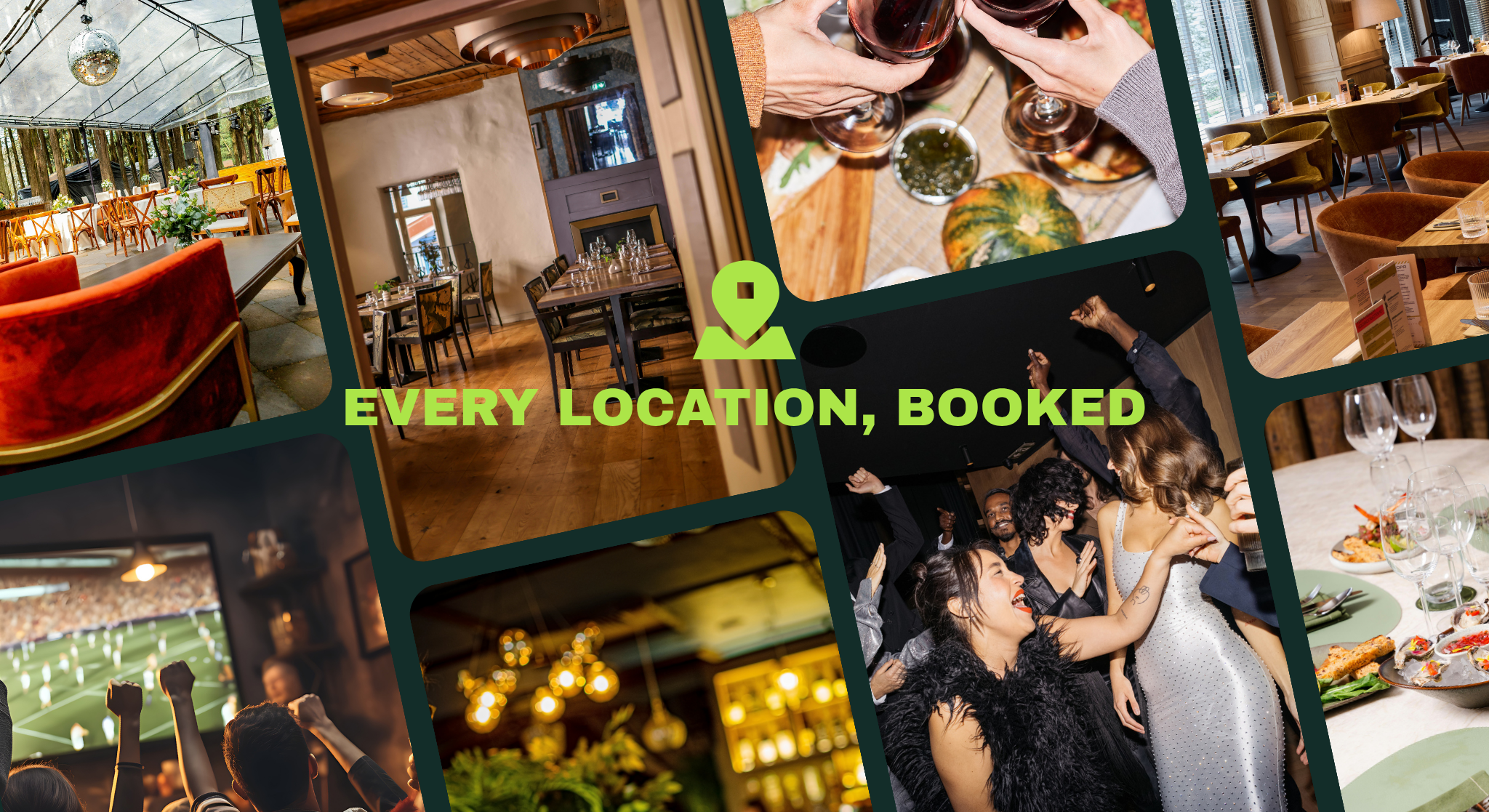
For hospitality groups, the holiday season is one of the most important revenue opportunities on the calendar. Corporate celebrations, client dinners, family gatherings, and end-of-year events can put private dining rooms and event spaces in high demand.
According to Tripleseat’s own data, Holiday booking inquiries jump 5–6x between October and November. For a multi-location hospitality group, that means every GM and event team can hit the surge at roughly the same time.
But across a multi-location hospitality group, that demand rarely lands evenly.
One restaurant may be fielding more inquiries than it can accommodate while another location in the same portfolio still has prime December dates available. A flagship venue may fill its private dining room weeks in advance while a sister concept a few miles away has room to grow.
That doesn’t necessarily mean guests don’t want the underbooked location.
Often, it’s a visibility and coordination problem.
When location-level teams are busy running day-to-day operations, group leadership needs a way to see booking pace across the portfolio, identify gaps early, and help local teams take action before the most valuable dates disappear.
The goal isn’t simply to have a strong holiday season at your best-performing locations.
It’s to get every door booked.
Here’s a practical holiday playbook for multi-location restaurant and hospitality groups that want to spread demand, capture more opportunities, and unlock more event revenue across their portfolio.
Why Holiday Event Demand Clusters Across Locations
Even within the same hospitality group, no two locations operate in exactly the same environment.
One restaurant might be surrounded by corporate offices. Another may depend more heavily on neighborhood traffic. One general manager might actively promote private events through local partnerships and social media, while another is focused almost entirely on operations.
Small differences can create major gaps during a compressed booking season.
Uneven holiday demand can come from factors such as:
- Different levels of local marketing activity
- Inconsistent use or placement of event lead forms
- Different competitive environments by neighborhood or market
- Variations in how quickly teams respond to inquiries
- Local teams prioritizing operations over proactive event sales
- Limited group-level visibility into lead volume, booking pace, and conversion
The instinct may be to solve an underbooked location with more marketing spend. But before adding budget, hospitality groups should first determine whether they have the process and visibility to understand where demand is going.
If one venue has more demand than it can handle while another has open inventory, you may already have an opportunity sitting inside your portfolio.
The challenge is seeing it, and acting on it quickly enough.
1. Build One Holiday Offer Kit, Then Let Every Location Make It Local
Multi-location hospitality groups face a familiar marketing challenge: How do you maintain brand consistency without making every location sound exactly the same?
The answer is to standardize the framework, not every word.
Before holiday inquiries accelerate, create a shared holiday offer kit that gives each location the foundation it needs to promote private events.
That kit could include:
- Holiday offer structure and promotional guidelines
- Email templates
- Social media assets and suggested copy
- Website and lead-form messaging
- Photography and brand assets
- Key campaign dates and deadlines
- Suggested follow-up messaging for event inquiries
Then give local teams room to adapt those materials.
A downtown steakhouse might emphasize polished corporate celebrations. A neighborhood restaurant could focus on festive family gatherings. A waterfront venue might lead with its view and atmosphere.
The campaign stays connected at the group level while each location gets to sell what makes it distinctive.
Kaskaid Hospitality provides one example of how a hospitality group can create a portfolio-wide reason to book. In a previous holiday campaign highlighted by Tripleseat, Kaskaid promoted a time-sensitive incentive for guests who booked holiday events at participating restaurants before a specified deadline.
The lesson isn’t that every hospitality group needs the same promotion. It’s that centralized strategy and local execution can work together.
Give every location the same starting line, then let teams sell the experience their local guests actually want.
2. Get Real-Time Visibility Into Holiday Booking Pace
This is where a multi-location holiday strategy becomes a revenue strategy.
Group leaders shouldn’t have to wait until January to discover that one location left valuable December dates unfilled.
They need to know while they can still do something about it.
During holiday booking season, leadership should have visibility into metrics such as:
- Leads by location
- Confirmed bookings by location
- Event revenue and forecasts
- Conversion performance
- Booking pace compared with previous periods
- Lead sources
- Remaining high-value dates or event opportunities
Then compare performance across the portfolio.
If six locations are pacing strongly and two are behind, those two venues become an immediate priority.
That’s one of the advantages of operating a multi-location group: performance data from across the portfolio can provide context that a single location doesn’t have on its own.
Tripleseat is built to give hospitality groups centralized visibility while allowing individual venues to manage their own leads, events, and bookings. For larger organizations, centralized dashboards and reporting can help leadership monitor performance by location, region, or concept and identify changes in booking pace earlier.
Tripleseat Insights takes that visibility further with customizable reporting, dashboards, historical analysis, and forecasting capabilities. Instead of relying on disconnected spreadsheets or waiting for individual managers to report back, teams can use event data to spot trends and make faster decisions.
The question shifts from:
“Why was this location slow during the holidays?”
to:
This location is pacing behind. What are we going to do about it this week?
That shift matters.
Tripleseat’s data shows that December alone can account for 12–13% of annual event revenue, roughly 50% more than an average month. For a multi-location group, spotting an underperforming venue early isn’t just a reporting exercise; it’s an opportunity to protect one of the most valuable revenue periods of the year.
Holiday dates are perishable inventory. Once December 12 passes, you can’t sell the private dining room for December 12 again.
Visibility gives your team time to act while the opportunity still exists.
3. Turn Overflow Into a Feature, Not a Lost Lead
A fully booked location is a win.
A guest who hears “we’re booked” and leaves your portfolio entirely is not.
For multi-location groups, overflow demand should have somewhere to go.
Imagine a guest searching for a 50-person company holiday dinner at Location A. Their preferred Thursday night is already booked.
The conversation shouldn’t end there.
Instead:
“That date is booked for us, but our sister location nearby has availability. Would you like me to connect you?”
Now an apparent dead end becomes another revenue opportunity for the group.
Building that behavior into your holiday sales process can take several forms.
Make location selection easy during inquiry
If your group operates multiple relevant venues, help guests understand their options from the beginning of the inquiry process.
Tripleseat lead forms can be configured for locations, helping inquiries flow into the event sales workflow rather than requiring teams to manually transfer information from disconnected systems.
Build sister venues into your response language
Give sales teams ready-to-use language for redirecting demand.
If a requested date, room, capacity, or experience isn’t available, suggesting another location should become a standard next step rather than an improvisation.
Train everyone to think portfolio-first
Event sales managers aren’t the only employees who receive private-event questions.
Hosts, managers, bartenders, servers, and front-of-house teams may all hear some version of:
“Do you host holiday parties?”
During peak booking season, make sure they know the answer, including what other venues within the group could work if their location can’t accommodate the guest.
A guest who wants to celebrate with your hospitality group is valuable demand.
Keep that demand inside your portfolio whenever possible.
4. Give Underbooked Locations a Late-Holiday Push
Even with strong planning, not every location will pace perfectly.
That’s why multi-location groups need a deliberate checkpoint before the holiday calendar is locked in.
About two to three weeks ahead of your priority booking dates, review performance across the portfolio and identify locations with available inventory.
Then get specific.
Instead of launching another group-wide campaign that sends even more demand toward locations that are already full, focus resources on the venues that need them.
Launch a location-specific offer
Create urgency around remaining dates or event spaces at the underbooked venue.
The incentive doesn’t always need to be a discount. Depending on your concept and economics, it could be an added experience, complimentary enhancement, or another value-add that makes booking compelling without unnecessarily reducing price.
Target the neighborhood
Use geo-targeted paid social campaigns to promote the specific location with availability.
The message can become far more relevant:
“Still planning your company holiday party? We have select December dates available in [neighborhood].”
That’s more actionable than promoting every venue equally.
Activate the local audience
Send a targeted email to guests and prospects relevant to that particular location.
Highlight the experience, remaining opportunities, event formats, and a clear path to inquire.
Mobilize the team
Your employees have networks, too.
If appropriate for your organization, consider a short-term staff referral initiative at the location that needs additional bookings. Give employees simple messaging and a clear process for directing potential event hosts to the sales team.
The important part is that the intervention happens before the season is over.
You can’t fix a slow December in January.
5. Make Holiday Pacing a Weekly Habit
None of this requires another hour-long meeting.
During your busiest booking window, a focused 15-minute weekly check-in can keep everyone aligned.
From October through December, review a consistent set of questions:
- How is each location pacing?
- Where are leads increasing or slowing?
- Which locations are converting demand?
- Where do we still have valuable availability?
- Where can overflow demand be redirected?
- What action does each underbooked location need this week?
Keep the meeting centered on exceptions rather than asking every location to deliver a lengthy update.
If a venue is pacing as expected, great.
If another is falling behind, spend the time there.
Over time, this creates something bigger than a holiday campaign: an operating rhythm for multi-location event revenue.
The same approach can be used for graduation season, wedding season, summer outings, year-end corporate events, or any other high-volume period.
Centralize the visibility. Identify the gaps. Give local teams the tools to respond. Measure what happens next.
Then repeat.
Every Location Is a Revenue Opportunity
The strength of a multi-location hospitality group isn’t simply having more venues.
It’s having more ways to say yes.
More spaces. More neighborhoods. More event formats. More available dates. More opportunities to match the right guest with the right experience.
But that advantage only works when your locations operate as a connected portfolio rather than isolated businesses.
The holiday season makes the stakes especially clear.
When leadership can see booking pace across locations, teams can respond before gaps become missed revenue. When marketing resources follow actual availability, underbooked venues get the attention they need. And when overflow leads can move naturally between sister properties, a sold-out venue can become a demand generator for the rest of the group.
That’s how multi-location hospitality groups turn visibility into action, and action into more booked events.
Source: Tripleseat proprietary data, based on event and booking activity across Tripleseat customers.
See Every Location’s Holiday Pipeline in One Place
Tripleseat gives multi-location hospitality teams a centralized system to manage event leads, bookings, and performance across their portfolio. With advanced reporting and Tripleseat Insights, leaders can dig into event performance, visualize important data, track trends, and make informed decisions while there’s still time to act.
Ready to get a clearer view of your event business across every location?