
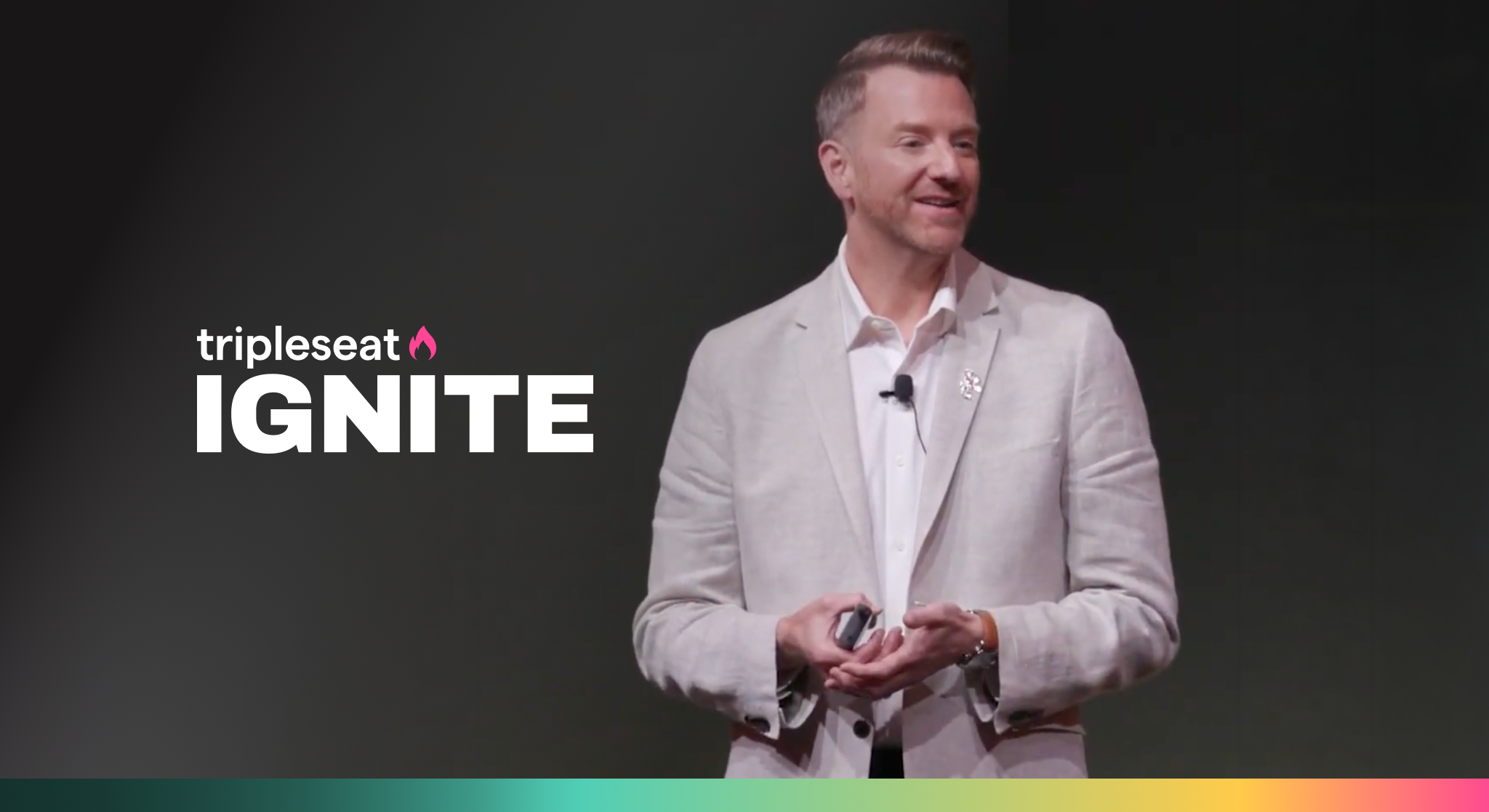
I spend a lot of time talking with hospitality operators, event teams, and the people responsible for turning demand into revenue. Earlier in my career, I was on the other side of the table. I spent more than a decade in restaurants and events, managing sales and helping a mid-sized restaurant group build a meaningful events business.
That experience still shapes how I look at the market today. I tend to look past the headline and ask a simpler question: What is actually happening in the business?
Right now, the answer is more encouraging than a lot of the economic noise would suggest.
The hospitality market is mixed. Consumers are being selective. Businesses are watching spend more closely. Costs have changed. Expectations have changed. And operators are being asked to do more with the same four walls.
But one thing is becoming increasingly clear from what we are seeing across the events business: people and businesses are still willing to spend when the occasion matters.
At Tripleseat, we analyzed more than 6 million events across 2025 and the first seven months of 2026. That gives us a pretty unique view into what is happening across demand, pricing, event size, conversion, catering, corporate bookings and self-service behavior.
The goal is not to find one magic number.It is to separate signal from noise and understand what operators can actually do with the information.
Here is what stands out to me.
1. What I’m seeing in the market
The biggest mistake I think operators can make right now is treating the market as a single thing. It is not.
Some areas of hospitality are under pressure. Traditional à la carte dining has been relatively flat, and there is evidence of consumers trading down in certain areas. At the same time, luxury and leisure travel remain strong, experiential spending continues to matter, and corporate event budgets are growing.
That tells me the consumer has not stopped spending. They are making choices about where they spend. That is a significant difference.
A person may decide not to go out for a routine dinner and still spend significantly to host a birthday, wedding shower, or anniversary. A company may scrutinize discretionary spending and still approve an event that serves a clear business purpose.
Events have something standard transactions often do not: a reason to exist. They create a moment, solve a business need or mark something important. That makes them harder to substitute.
And we are seeing that in the numbers.
2. The economy is mixed, but event demand is still moving
The broader economic picture is not one of explosive growth, but it is also not one of broad contraction. 2026 GDP growth forecasts range from 1.8% to 2.6%, compared with 2.2% in 2025. That matters because the sentiment you hear in hospitality can sometimes feel worse than the underlying economic data.
Customers are more selective. Businesses are scrutinizing spending. Everyone is feeling pricing pressure. But economic activity has not stopped.
For event operators, I think the important distinction is this: a more selective buyer is not the same thing as a nonexistent buyer. The demand is there. The question is whether your business is positioned to earn it.
That means being sharper about value, clearer about the experience you are offering, disciplined about pricing and providing an easy buying experience.
The Tripleseat data supports that opportunity. Average event revenue per customer increased 4.4% year over year, and corporate event activity continues to be an important part of the mix.
Venues can capture that growing demand, but they may need to execute differently in a more selective market.
3. Events help facilitate a more predictable business model
One of the things I appreciated most about running events earlier in my career was not just the revenue. It was the predictability.
Standard service is fundamentally about selling seats. Events allow you to sell an experience and an outcome, and that changes the economics.
With an event, you may have a defined guest count, a minimum, a menu, a deposit and staffing requirements planned weeks in advance. You can make better decisions about food costs, labor and scheduling before the guests ever walk through the door. All of these things reduce volatility.
There is a huge operational difference between hoping you fill 50 seats on a Tuesday night and knowing six weeks in advance that 50 people are coming in, what they are spending and what you need to execute the experience. That predictability has value beyond the top line.
The best event programs are not simply filling unused rooms or empty seats. They are creating a more predictable operating model. That is one of the biggest reasons I continue to believe events should be viewed as a core part of the business, not an adjacent revenue stream.
4. Revenue growth is coming from scale, not just price
This is one of the most important signals in the data.
In the U.S., average price per person moved from $72 in 2025 to $74 in 2026, an increase of about 2.8%. At the same time, overall event revenue increased 4.4%.
That tells me something important. Yes, pricing matters. Operators should absolutely revisit their pricing and make sure it reflects the market they are actually operating in today. But the growth is not coming from price alone. It is coming from more and bigger events.
That shifts the conversation. Instead of asking only, “How do I charge more?” I would also ask: How many qualified leads are entering the funnel? How quickly are we responding? How many are converting? How big is the average event?
Those operational levers can have a bigger impact than adding a few dollars to the menu price. Growth is a math equation. Price is one part of it. Volume and conversion matter just as much.
5. The event opportunity is broader than the biggest occasions
The obvious event categories are still important. Corporate meetings, weddings, cocktail receptions, holiday parties and birthdays remain major drivers of demand.
But there is another story developing underneath those categories. Mid-tier events are growing too.
We are seeing increased booking around happy hours, graduations and bridal showers. These are not necessarily the massive, once-a-year occasions that operators have traditionally built their sales strategy around.
They are smaller moments that people are increasingly choosing to celebrate outside the home. That creates a much broader addressable market.
I would not build an event strategy around only the largest occasions. There is meaningful revenue in the moments between them.
6. Catering expands the playing field for restaurants
Catering may be one of the most underappreciated growth opportunities for restaurants right now.
Your restaurant has a fixed number of seats. Your event space has a fixed number of rooms. Your real estate creates a physical ceiling on how much business you can do. Catering changes that equation.
In our data, average catering revenue per venue increased from about $18.6K in 2025 to $20K in 2026. Average catered event revenue increased from $1,600 to $1,800, and guest counts increased as well.
This is not simply more small orders. Catered events are becoming more valuable.
And catering does not have to mean building a massive full-service operation. It could be as simple as group pickup and dropoff orders. The right model depends on your kitchen, labor, brand and clients. The bigger idea is that you can create more revenue without adding another dining room.
7. Demand is value, but conversion is where operators win
This is where my sales background comes back into the conversation.
Demand is important, but demand does not automatically become revenue. Average lead conversion is around 18% this year and has dipped slightly from 2025 averages.
At first glance, that may not sound like much. But think about the math. If 82 out of every 100 inquiries are not converting, there is potentially a significant amount of revenue sitting inside your existing funnel.
Before spending more money trying to generate more leads, I would want to know whether the team is doing enough with the leads coming in today.
How quickly are you responding?
What does the first response look like?
How easy is it to understand the offer?
How transparent is the pricing?
How much back-and-forth does it take to get to a decision?
How strong is the follow-up?
These are sales questions, but they are also operational questions. I learned early in my career that you can have a great sales team and still lose business because the process is hard. In a market where customers have more options and more information, every inquiry is more valuable.
8. Customers are expecting a different buying experience
This is one of the biggest shifts I see.
Fast responses used to be impressive. Today, they are expected.
Personalization used to mean adding more and more customization. I don’t think that is the right definition anymore. Personalization can simply mean making an experience feel designed for the occasion that matters to the customer.
That distinction is important because infinite customization is often bad for the operator. It creates complexity in sales, the kitchen, staffing and service. At the same time, customers increasingly expect digital convenience. They want to know availability, price and options without having to make three phone calls and send twelve emails.
That is why self-service booking is growing and not only for catered events.
Our data showed a 60% increase in on-premise bookings through Tripleseat Direct Book. Direct-booking revenue and event volume per venue also increased.
I do not see self-service as a replacement for hospitality or salespeople. I see it as a way to match the sales effort to the complexity of the purchase. A complex, high-value event should get a high-touch experience. A straightforward transaction should not require one.
The best customer experience is often the one with the least unnecessary friction.
9. The price floor and guest expectations have changed
Costs have changed. Labor has changed. Customer expectations have changed. The competitive landscape has changed.
So I do not think operators should continue pricing events based on what they historically charged. The better approach is to build a comp set of similar venues, understand what customers are seeing in your market and make sure your packages reflect the value you actually deliver.
I also think simplicity matters more than ever. A strong event offering should have three layers: a base package, a premium package, and a menu of add-ons or experiences.
The base package provides an accessible entry point with healthy margins.
The premium package raises spend and brings in signature items.
Add-ons create opportunities to make the event more memorable through things like a champagne toast, signature cocktail or takeaway gift.
The best packages do two things at the same time: they make the guest feel like they are getting something special, and they make the operation easier to execute. That is the win!
10. What I would be doing right now
If I were running an events business today, I would focus on five things.
First, I would audit pricing and simplify packages. Make sure pricing reflects the current market and that the offer is easy for both the guest and your operations team to understand.
Second, I would identify the most profitable segments and get much more intentional about targeting them. Not every event is equally valuable, and marketing should reflect that.
Third, I would build or strengthen off-premise options. Your four walls are a constraint. Catering gives you another way to monetize your kitchen, brand and team.
Fourth, I would look at the booking process exactly the way a customer does. How many calls, forms, emails and handoffs does it take to buy? Anywhere the answer is “too many,” simplify it. This could be in the form of a direct-booking experience and/or pairing down menu options.
Fifth, I would make corporate business a deliberate part of the pipeline. Understand which companies and event types already fit your product, then make it easy for planners to say yes.
None of these ideas is revolutionary on its own. The advantage comes from doing all five consistently.
The opportunity is there. But market growth does not guarantee your growth.
Demand creates the opportunity. Execution captures it, and that is where you should be focused!
Want to hear more about what Chris is seeing across the events industry?
Watch Chris Pridemore’s full session from the Ignite stage, where he breaks down the data, trends, and opportunities shaping event revenue right now.
Watch the full session